Deep Pressure Therapy (DPT) for PTSD: How It Works and How Dogs Are Trained
Deep Pressure Therapy—often shortened to DPT—is one of the most requested tasks for PTSD service dogs, and for good reason. When PTSD symptoms spike, the thinking brain can go offline. You can know you’re safe and still feel like you’re not. In those moments, “just breathe” may not land. Talking yourself down can feel impossible. What many people need isn’t more thinking—it’s a body-level reset.
That’s where DPT can help.
DPT is not a cure for PTSD. It won’t erase trauma or guarantee you’ll never panic again. But as a trained, repeatable task, it can help you come back to the present faster—especially during panic attacks, dissociation, flashbacks, shutdowns, and nighttime distress.
In this guide, we’ll break down what DPT is, why it works for many PTSD handlers, when to be careful, and how to train it ethically and safely.
What is Deep Pressure Therapy (DPT)?
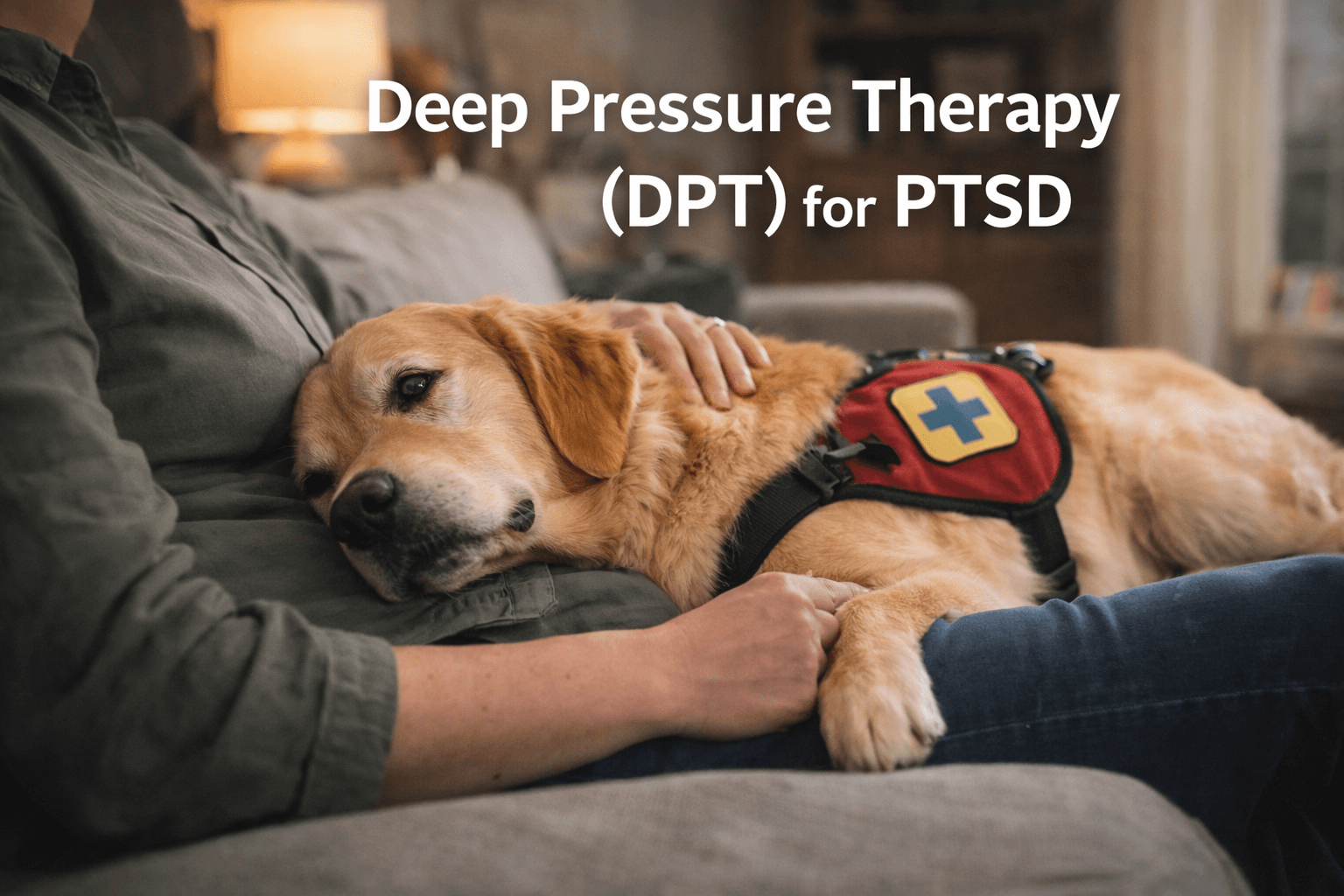
Deep Pressure Therapy (DPT) is steady, calming weight and contact applied in a controlled way. If you’ve ever felt relief from a weighted blanket, a firm hug, or a heavy comforter, you’ve already experienced the basic idea.
The key difference between “my dog cuddles me” and “my dog performs DPT” is structure:
A DPT task is trained. It is:
- offered on cue (for example, “pressure”) and/or as part of a trained response plan
- applied in a safe position chosen for your body and your dog’s size
- held calmly for a duration you build over time
- ended on a clear release cue (for example, “off” or “all done”)
In other words: DPT is a skill the dog can perform reliably, not just affection.
How DPT can help PTSD (without the jargon)
PTSD doesn’t only live in memories—it can live in the nervous system. When PTSD symptoms flare, your body can shift into a threat state: fight, flight, freeze, or shutdown. You might feel:
- tight chest or racing heart
- shaking or tingling
- dissociation (“floating,” numbness, unreality)
- spiraling thoughts or sudden overwhelm
- difficulty speaking or making decisions
In those moments, DPT can help by providing strong, steady physical input. That pressure becomes an anchor. It can:
- pull attention back into the body
- reduce the feeling of spinning or floating
- support slower breathing and calmer rhythm
- give your brain a predictable sequence: “When this happens, we do this.”
Not everyone responds to pressure the same way, and that’s important to say clearly. Some people love pressure and feel calmer immediately. Others find pressure triggering. The goal is not to force DPT—it’s to build a tool that genuinely supports you.
Who DPT tends to help most (and when to be cautious)
People who often benefit
DPT can be especially helpful if you experience:
- panic attacks (especially the “body storm” sensation)
- dissociation or shutdown
- flashbacks that make you feel stuck in the past
- nighttime panic-on-wake after nightmares
- sensory overload or overwhelm
Many handlers notice that if a weighted blanket helps, DPT often helps too.
When to be cautious
DPT isn’t for everyone, and sometimes it needs medical input first. Consider extra caution if you have:
- breathing issues (or pressure on the chest feels uncomfortable)
- chronic pain areas where contact could flare symptoms
- certain cardiac conditions
- trauma experiences where physical pressure feels unsafe
- strong startle responses where you might push the dog off abruptly
- a dog that is either too small to give meaningful pressure or too large to apply pressure safely
If pressure feels even slightly unsafe or triggering, DPT can be modified into lighter tasks like a chin rest or side lean rather than full-body contact.
Types of DPT positions (choose what fits your body + your dog)
A good DPT plan matches your size, your dog’s size, and your mobility. There isn’t one “correct” position.
Lap DPT (common for small-to-medium dogs)
The dog lays across your thighs while you sit.
Why it works: stable, easy to control, doesn’t compress the chest.
Good for: panic attacks, tremors, grounding.
Chest/torso lean (common for medium-to-large dogs)
The dog leans with controlled weight while you sit.
Why it works: strong contact without full body-on-body.
Best practice: keep it gentle and stable, not sudden.
Side DPT (lying down)
Dog presses along hips/legs while you lie on your side.
Why it works: supportive in recovery moments, especially after nighttime episodes.
Chin rest / partial pressure (public-friendly)
Dog rests chin on your leg or hand for steady contact.
Why it works: discreet, low-impact, highly usable in public.
Paws-up + lean (advanced)
Dog places front paws on your legs/bench and leans.
This can be effective but must be trained carefully to avoid slipping and joint strain.
What “good DPT” looks like (quality standards)
Well-trained DPT has a specific feel:
- the dog moves into position calmly
- pressure is steady, not frantic
- there is no scrambling, climbing, or pawing
- the dog can hold for a short duration
- the dog ends immediately when released
- the dog remains neutral to people and distractions
If your dog is excited, wiggly, or “performing” for attention, that’s a training sign—not a failure. It just means you’re still building calmness and clarity.
How dogs are trained for DPT (step-by-step, owner-trainer friendly)
The safest way to train DPT is to build it like a calm routine—not as an emergency skill first.
1) Start with prerequisites
Before you train DPT, your dog should be comfortable with:
- handling and body contact
- “settle” on cue
- “off” / “leave” / “all done”
- calm behavior on furniture (if allowed) or a stable mat position
2) Teach the position first (no pressure yet)
For lap DPT, you may start by luring your dog onto your thighs gently, marking and rewarding calm placement. At first you’re not asking for weight or duration—just “this position is safe and rewarding.”
3) Add the cue only after the behavior is predictable
Once your dog understands the position, name it:
- “pressure”
- “lap”
- “help”
Pick one word and keep it consistent.
4) Build calm duration slowly
Start tiny:
2 seconds → 5 seconds → 10 seconds → 30 seconds → 60 seconds.
Reward stillness. If your dog shifts constantly, shorten the time and reward earlier. You’re training the nervous system of the dog too—calm is part of the task.
5) Add the release cue (this is non-negotiable)
Teach “off” or “all done” so the dog stops immediately.
Then reward the release. This keeps the dog from “insisting” on contact and keeps DPT clearly cue-based.
6) Proof the skill in real-life contexts
Once it’s calm and reliable at home, you can practice in gentle real-world settings:
- in the car
- on a quiet bench
- in a calm corner of a park
- (later) in quiet public environments where your dog can remain neutral
Training DPT as a response to symptoms (optional/advanced)
Some handlers want their dog to offer DPT when symptoms appear—like shaking, pacing, or breath change. This can be helpful, but it must be trained thoughtfully to avoid creating a clingy dog who “worries” about your emotions.
A balanced approach is:
- start with cue-based DPT
- build strong “reset/settle” after DPT
- only then capture early signals carefully
- reinforce calm response, not urgency
DPT should feel like a supportive tool, not a constant monitoring system.
Safety: protecting both handler and dog
Safety is part of ethical task training.
For the handler:
- avoid pressure on the throat/neck
- avoid sensitive injury areas
- choose positions that don’t compromise breathing
- keep DPT optional—consent matters
For the dog:
- keep nails trimmed to avoid scratches
- avoid repeated jumping on/off furniture
- train on non-slip surfaces
- watch for fatigue—dogs need real rest to work well
DPT in public: etiquette + practical tips
Some DPT styles are very public-friendly:
- chin rest
- side lean
- lap DPT on a bench (if space allows)
The biggest public access rule is simple: don’t block aisles or create trip hazards. If the environment is too tight or chaotic, it may be better to use “find exit” or “find seat” first and do DPT in a calmer spot.
Common mistakes (and what to do instead)
Mistake: rewarding climbing or frantic contact.
Better: reward calm placement and stillness.
Mistake: skipping the release cue.
Better: always include “off/all done” and reward it.
Mistake: training only in distress.
Better: build the skill calmly first, then use it in real moments.
Mistake: pushing duration too fast.
Better: shorten, reward earlier, rebuild calmly.
Conclusion: DPT is a body-based bridge back to safety
DPT is popular because it meets PTSD where it often lives—in the body. When trained ethically, it can shorten panic, reduce dissociation, and help you recover faster in both daytime and nighttime episodes.
If you’re considering DPT, keep it simple:
calm cue → safe pressure → short hold → clear release → settle.