“Cover” and “Block” Tasks: How PTSD Service Dogs Create Space in Public
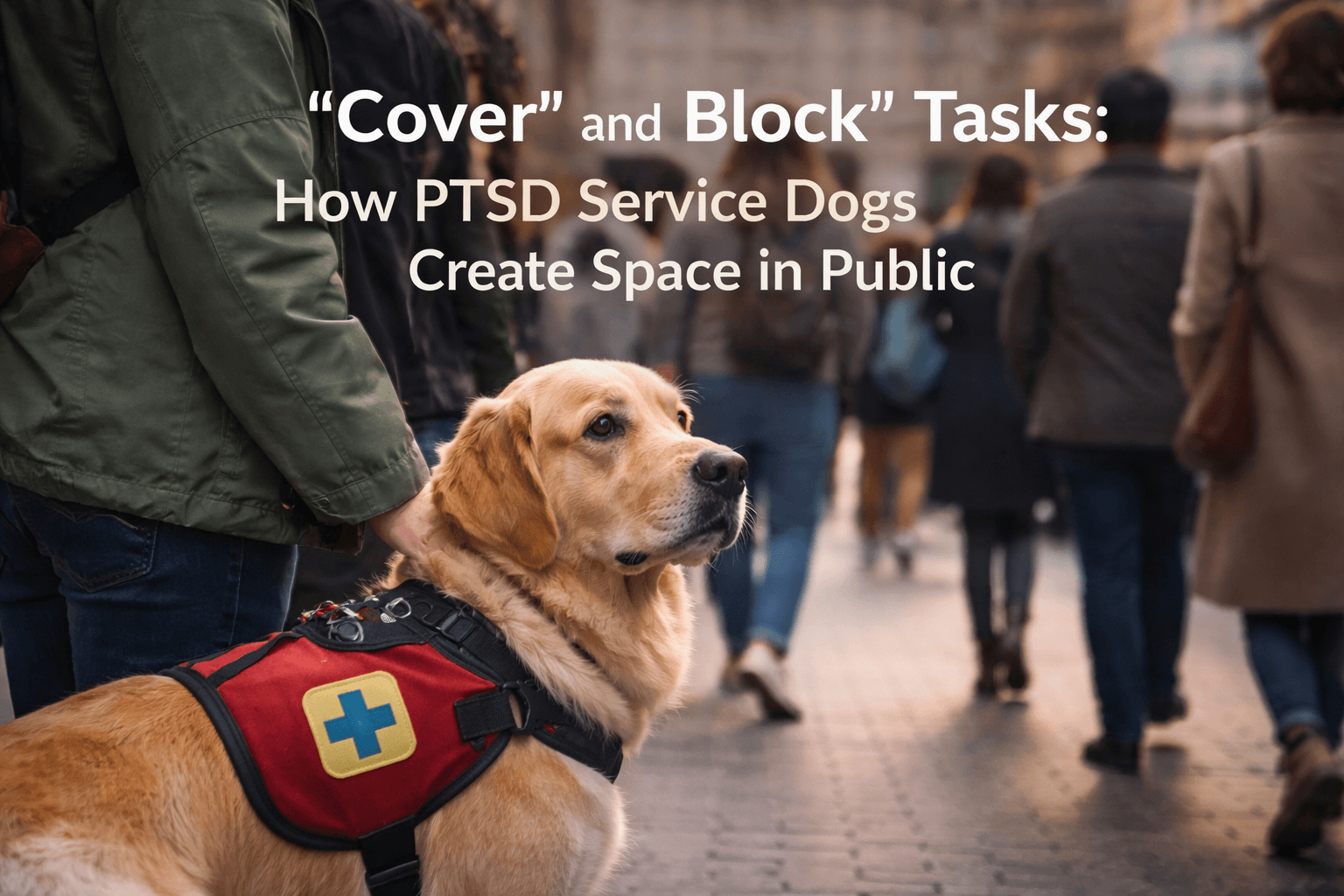
If you live with PTSD, being in public can feel like your nervous system is doing two jobs at once: trying to complete the errand in front of you while also scanning for danger. Crowds, lines, tight aisles, and strangers stepping too close can trigger hypervigilance, panic, or a shutdown—even when nothing “bad” is happening.
This is where “cover” and “block” tasks can be life-changing. They’re not about protection work. They’re not about intimidation. They’re about something much simpler and more human: creating predictable space so your body doesn’t have to constantly brace for impact.
When trained correctly, cover and block give you a steady, repeatable tool in moments when words, logic, and coping skills feel far away.
What “cover” and “block” really mean
It helps to define these in plain language, because they’re often misunderstood.
Cover means your dog positions behind you (often facing outward). This is useful if approaches from behind trigger a strong startle response. Many handlers describe cover as helping their body “stop spinning” because they don’t feel exposed.
Block means your dog positions in front of you or slightly to the side, creating a gentle buffer. This is helpful in checkout lines, elevators, waiting rooms, and other spaces where strangers naturally stand close.
Both tasks are essentially positioning behaviors on cue. The dog stays calm. The dog stays neutral. The dog does not stare people down, bark, growl, or “guard.”
That last point matters: these are legitimate PTSD service dog tasks when trained to mitigate disability symptoms, but they must be controlled and polite to remain safe and appropriate in public.

Why these tasks help PTSD (the nervous system piece)
Hypervigilance isn’t a personality flaw. It’s a survival response. The body learns that scanning, bracing, and monitoring proximity helps prevent harm. Even after you’re safe, the nervous system can keep running that old program.
Cover and block can reduce the burden on your brain and body by creating:
- predictability (the dog is in a known position)
- a physical “anchor” (your attention has a stable focus)
- less surprise (especially with cover)
- more control over personal space without confrontation
The goal isn’t “I never feel anxious.” The goal is: I can stay in the situation without escalating.
Where cover and block are most useful (real life, not theory)
These tasks shine in places where proximity and unpredictability are unavoidable:
- Checkout lines where people creep closer behind you
- Cafés and restaurants where servers pass close or people squeeze through aisles
- Public transit platforms where you can’t control who stands near you
- Medical waiting rooms where seating is tight and exits feel far
- Elevators where you’re surrounded and stuck for a moment
- Crowded sidewalks where people brush past without noticing
In these moments, your dog isn’t “protecting” you. Your dog is giving your nervous system a structured option: Stand here. Breathe. You have space.
How cover and block fit into a bigger “task stack”
Most handlers don’t use these tasks alone. They often work best as part of a short sequence:
Interrupt → Block/Cover → Ground → Guide (exit/seat) → Recover
For example:
- Your dog nudges you when anxiety rises (interrupt)
- You cue block while you breathe (space)
- You cue chin rest for grounding (regulate)
- If it escalates, you cue “find exit” (leave safely)
This keeps you from relying on a single tool when your body needs multiple steps.
Training prerequisites (so the task stays calm, not tense)
Cover and block only work if your dog is already stable in public. If a dog is anxious, reactive, or overly social, positioning tasks can accidentally become messy or confrontational.
Before you teach cover/block, your dog should reliably have:
- a calm heel/loose leash
- strong “leave it” (no sniffing strangers, food, or carts)
- a real settle in busy environments
- confidence around crowds, noise, and movement
- a consistent “release” cue (so the dog doesn’t self-assign duties)
Think of it this way: block and cover are like “quiet posture” skills. They require emotional steadiness.
Step-by-step: teaching “block” (front or side buffer)
Start simple and teach it like any other position.
Phase 1: teach the position
Most handlers start with a front block:
- you stand still
- dog steps in front of you
- you reward the position
Then add a side block at the hip for tight spaces.
Phase 2: add the cue and duration
Once your dog reliably hits the position:
- name it (“block”)
- add 2 seconds → 5 seconds → 10 seconds
- reward calm stillness, not scanning
Phase 3: practice in low-pressure public settings
Start in quiet places, then gradually move toward real-life:
- quiet aisle → busier aisle
- short wait → longer wait
- friend walking past → multiple people passing
The secret isn’t intensity. It’s repetition without stress.
Step-by-step: teaching “cover” (behind position)
Cover is often helpful for startle triggers.
Phase 1: teach “behind” as a comfortable place
You cue behind, dog steps behind you, you reward.
Phase 2: build calm duration
You want your dog to stay behind without creeping, circling, or leaning into strangers.
Phase 3: use it briefly and release it
This part is important: cover should not become “all the time.”
A short cue, a short hold, then release back to normal walking keeps the dog calm and prevents the dog from becoming hypervigilant.
Public access etiquette: how to use these tasks without conflict
Because these tasks affect how much space you take up, it’s wise to use them in the smallest, calmest way possible.
Good handler habits include:
- keeping the dog close and tucked when space is tight
- using block as a soft buffer, not a barrier
- avoiding argument—use “find exit” if someone crowds you
- practicing a polite one-line script:
- “Please give us a little space—thank you.”
And always remember: if a business or staff member feels your dog is blocking aisles or creating hazards, it can create friction. Clean training and respectful positioning prevent most of that.

Can a business deny access if you use block/cover?
Under the ADA, a business generally can’t deny access because a dog performs a legitimate task. But they can require removal if the dog is:
- not under control
- not housebroken
- behaving aggressively
- repeatedly barking or disrupting operations
So the key is making sure block/cover stays:
- quiet
- controlled
- proportional to the space
- not interfering with traffic flow
A well-trained block looks like “polite waiting,” not “security detail.”
Common mistakes (and the kinder alternative)
Mistake: letting the dog stare or scan.
Alternative: reward soft focus, neutrality, and calm stillness.
Mistake: using block to push people away.
Alternative: use the smallest block possible, then choose to move if needed.
Mistake: training in crowds too early.
Alternative: proof slowly, starting in quiet environments.
Mistake: turning cover into constant “watch my back.”
Alternative: cue it briefly, then release; avoid training the dog into anxiety.
Is cover/block a legitimate PTSD service dog task?
Yes—when trained to mitigate PTSD symptoms like hypervigilance, panic triggers, and startle response.
If asked what your dog does (the ADA-allowed question), a simple answer might be:
- “He’s trained to create space behind/in front of me to reduce panic triggers.”
No paperwork required for public access. Just real training and appropriate behavior.