Best Breeds for PTSD Service Work (and Why Breed Isn’t Everything)
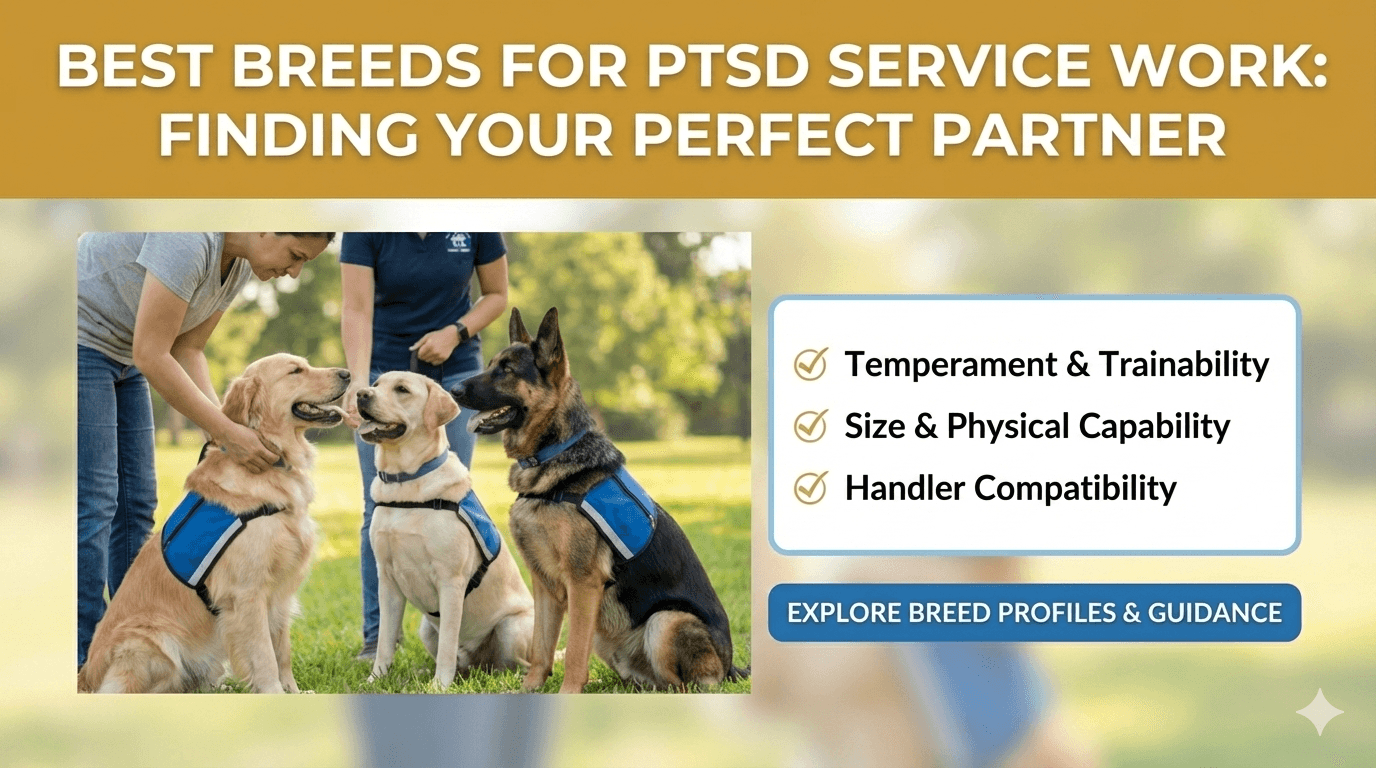
When people start researching a PTSD service dog, one of the first questions they type into Google is: “What’s the best breed for PTSD?” It makes sense. Breed feels like a shortcut—like if you pick the “right” dog, everything else will fall into place.
But here’s the honest truth: breed can influence tendencies, but it doesn’t guarantee service-dog success. For PTSD service work, the individual dog’s temperament, stability, health, and training matter far more than the label on the paperwork.
This article will help you choose wisely by doing two things:
- explaining what PTSD service work truly requires, and
- walking you through breeds (and breed groups) that often fit the work—plus what to watch out for.
What PTSD service work actually requires
A PTSD service dog usually needs to do two jobs at the same time:
1) Public-access neutrality
The dog must be able to function calmly in real-world environments—stores, sidewalks, waiting rooms, hotels, airports—without causing a disruption.
That means the dog can:
- ignore strangers trying to interact
- ignore other dogs
- ignore food smells and dropped items
- stay under control on leash
- settle quietly (often for long periods)
- recover quickly if startled by noise or movement
PTSD handlers often deal with overstimulation. If the dog also becomes overstimulated, the team struggles.
2) Trained tasks that mitigate PTSD symptoms
A service dog is defined by trained work or tasks that help with disability symptoms such as:
- panic attacks
- dissociation or shutdown
- nightmares and night terrors
- hypervigilance and startle response
- getting “stuck” or unable to exit situations safely
Some common PTSD service dog tasks include:
- interruption (nudging/paw targeting to break spirals or grounding during dissociation)
- DPT (deep pressure therapy) (cue-based, safe pressure to help regulate)
- find exit / guide to a quiet place
- nightmare interruption
- cover/block (calm positioning to create space—not guarding)
So, the “best breed” for PTSD service work is less about appearance and more about the dog’s ability to stay calm, think clearly, and work reliably.
Why breed isn’t everything (and what matters more)
Breed matters in the sense that breeds were developed for different jobs. That history influences:
- energy level
- sensitivity to motion/noise
- sociability or suspicion
- prey drive
- stamina
- handler focus
But within every breed, there’s huge variation. You can meet:
- a Labrador who is anxious and reactive
- a Shepherd who is calm and neutral
- a mixed breed who is steady enough to work beautifully
That’s why temperament testing and selection are everything—especially if you are owner-training.
A useful way to think about it:
- Breed can raise or lower the odds.
- The individual dog determines the outcome.
The temperament traits that matter most for PTSD service dogs
If you’re choosing a candidate, these traits usually matter more than breed:
Low reactivity
A dog that reacts strongly to:
- strangers
- dogs
- sudden noises
- fast movement
will have a harder time with public access.
Fast recovery after startle
Startle happens. The key is what the dog does after.
A strong candidate may notice a loud sound, then quickly reset and continue calmly.
Strong settle ability
One of the most underrated service dog skills is simply:
“Can this dog relax and do nothing in public?”
If a dog can’t settle, the team burns out.
Neutral friendliness (not extreme)
For PTSD work, you usually want a dog who is:
- not suspicious of people
- not desperate to greet everyone
Neutral is ideal.
Confident, not “protective”
This one matters. PTSD handlers often want to feel safe—but a dog that behaves protectively (staring, stiff posture, guarding, growling) is a public access risk and can escalate conflicts.
A PTSD service dog should create safety through calm, trained tasks, not intimidation.
Breed groups that often fit PTSD service work (and why)
No breed is perfect for everyone. But some breeds and breed groups tend to produce traits that align well with psychiatric service work—especially public access.
Labrador Retriever
Labradors are popular for service work for practical reasons:
- typically stable and people-neutral
- biddable and forgiving with training mistakes
- food motivation makes training easier
- often resilient in busy environments
Watch-outs:
- adolescence energy and “go-go-go” phase
- food scavenging
- over-friendly greetings if not trained early
A well-bred Lab with consistent calm training can be an excellent PTSD candidate.
Golden Retriever
Goldens often shine in PTSD work because they tend to be:
- gentle and handler-oriented
- naturally tuned to human emotion (helpful for interruption tasks)
- comfortable with body contact (useful for DPT)
Watch-outs:
- some lines can be more sensitive (noise, pressure, emotional energy)
- grooming and shedding needs
- adolescence excitability
A stable, confident Golden can be a wonderful psychiatric service dog—especially when calm neutrality is built early.
Standard Poodle
Standard Poodles are often overlooked, but they can be excellent service dogs:
- highly trainable
- strong pattern learning for task work
- low-shedding (a practical need for some handlers)
- often elegant, stable movers in public
Watch-outs:
- some can be environmentally sensitive
- require careful early socialization and calm exposure
- grooming needs are ongoing
With proper selection and structure, Standards can be standout PTSD service dogs.
Smooth Collie / Rough Collie (good fit for some)
Collies can be a great match for certain PTSD handlers because many are:
- soft and responsive
- naturally inclined to stay close
- good at “settle” with the right training approach
Watch-outs:
- some can be sound-sensitive
- may not thrive in chaotic environments
- may struggle if the handler’s lifestyle is high-intensity and unpredictable
Collies tend to fit best for quieter routines, consistent structure, and calm public exposure.
Mixed breeds (the “unicorns”)
Some of the best service dogs are mixes. The advantage is you may find:
- a naturally neutral temperament
- strong resilience
- a stable body type that fits your needs
The risk: selection. Mixed-breed success depends heavily on temperament testing and health evaluation, because predictability is lower than with well-bred lines.
Breeds that can work—but require extra careful matching
Some breeds can absolutely succeed in PTSD service work, but they often require more experienced handling, stronger early training plans, or very specific individuals.
Herding breeds (Australian Shepherds, Border Collies, etc.)
These dogs are brilliant and responsive, which can help task training. But herding breeds often carry:
- motion sensitivity
- environmental vigilance
- higher reactivity risk if not carefully raised
They may notice everything—and for a PTSD handler, that can add pressure.
Herding breeds tend to succeed best with:
- experienced trainers
- structured routines
- careful neutrality work
- calmer environments rather than constant crowds
Guardian breeds (German Shepherds, Dobermans, etc.)
Some handlers feel drawn to these breeds because they associate them with safety. But the challenge is:
- public perception (people often fear large “serious-looking” dogs)
- higher risk of suspicious or guarding behavior in some lines
- more scrutiny in public access settings
A stable, neutral Shepherd can succeed, especially with professional guidance. But for PTSD service work specifically, you must avoid any training that encourages “watching people” or guarding.
High-prey-drive and terrier types
These breeds can be bold and confident, but often:
- struggle with impulse control
- have strong chase instincts
- may react to small animals, movement, or other dogs
They can work in rare cases, but usually aren’t the easiest path for psychiatric service work.
Health: the hidden “breed factor” people ignore
Even a perfect temperament won’t matter if the dog can’t physically sustain working life.
Things to consider:
- orthopedic screening for medium/large dogs (hips, elbows where relevant)
- breathing and heat tolerance (flat-faced breeds can struggle with travel and stamina)
- genetic risks in popular breeds (ethical breeding matters)
- overall longevity (you want a dog that can work safely for years)
For PTSD service work, you need a dog who can handle:
- long settle periods
- daily outings
- emotional steadiness without fatigue
How breed affects specific PTSD tasks (practical matching)
Instead of asking “what breed is best,” it can be more useful to ask:
“What kind of dog fits the tasks I actually need?”
DPT (deep pressure therapy):
- usually benefits from a dog with enough size and calm body contact
- small dogs can still do grounding pressure, but expectations must match size
Interruption tasks:
- often easier with dogs who enjoy engaging with the handler without being pushy
- persistence is helpful, but calmness matters
Nightmare interruption / sleep support:
- requires a dog who settles well, moves calmly at night, and isn’t jumpy
Cover/block:
- needs stable confidence and neutrality
- must never become guarding or suspicious
Find exit / guide:
- needs environmental confidence and steady leash navigation
Common myths (and what’s more accurate)
Myth: “Any dog can be a service dog if trained enough.”
Reality: Many dogs can learn tasks, but not all dogs can handle public access stability.
Myth: “You need a big dog for PTSD.”
Reality: You need the right temperament and task match. Some small dogs can do powerful interruption and grounding tasks.
Myth: “Protective breeds are best for PTSD.”
Reality: PTSD service work is not protection work. Neutrality and calm task performance are what protect your access and safety.
Myth: “Breed guarantees success.”
Reality: Selection, health, and training structure matter more than the label.
A practical way to choose: the “best fit” method
If you want to make a wise choice, focus on these steps:
- Define your top 2–4 symptoms you want the dog to help with
- Choose tasks that match those symptoms
- Choose the dog whose temperament can handle public life
- Use breed as a guide—not as a promise
A stable dog that can settle, recover from surprises, and stay neutral in public is often more valuable than any “top breed list.”
Final takeaway: the best breed is the stable individual
The best “breed” for PTSD service work is usually:
- calm
- resilient
- neutral in public
- trainable
- able to settle
- physically healthy
- and matched to your environment and task needs
Breed may raise the odds, but the individual dog decides the outcome.
If you’re choosing a candidate, prioritize temperament and health first. Then build skills in layers—foundations, public access, tasks, proofing. That’s how real PTSD service dog teams are built.